new-year-pictures creator - logo

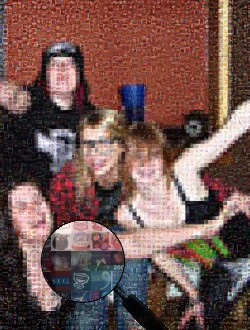
New year 2010 Eve photos like confetti, drinks, parties, fireworks, 'Best wishes for 2010', 'Happy new Year!!!' for online and free photomontage of mosaics.

Pages for direct access to image galleries:

Cat Dog Bird
Flower Cactus
Love Pretty Men Pretty Women Smiley
Car Bike Truck Train
Venice Paris Las Vegas Islands
BirthDay Christmas

New Year

Mother Day

new-year-pictures - english language Welcome!
new-year-pictures - french language Bienvenue!
Examples Help Results Printing


  • What contains the New Year 2010 photo library?

    • images of New Year Eve, confetti, champagne, fireworks, expressions like "Best wishes 2010", "Happy New Year", cakes, gif boxes...

  • Can I add other galleries seen on the Pictosaic?

    • Yes. The picture library New Year 2010 can be merged with other proposed galleries, as the "Christmas" to refer to the holiday season year.

  • And insert my private photographs into the mosaic?

    • Yes. Such as add pictures of your memorable New Year Eve with your best friends.

  • An idea of a personnalized photomontage?

    • Send by e-mail your wishes of new year 2010 with a mosaic made from your family photo album.


Why the year begins on 1 January:

Not so simple...

  • It seems clear that January 1 marks the beginning of a new year. But that date has origins more complex than it seems for two reasons.

  • Firstly, all countries don't use the same annual cycle, and therefore have no reason to celebrate New Year on January 1. The duration of one year may not even be fixed. This is the case of the Chinese calendar, which takes into account both the lunar and solar cycles.

  • And then, this date was not always in the same place in Western countries. A little history is needed ...


The Gregorian calendar

    The Julian Calendar was required by Julius Caesar
  • The Gregorian calendar is a solar calendar, based on the Julian calendar.

  • And Julian is an evolution of the Roman calendar desired by Julius Caesar (hence its name) in 46 BC.

  • This calendar is used in most countries, especially in Western countries.


The 365.2425 days problem

  • The year corresponds to a rotation of the earth around the sun. During this period, the Earth is about 365.25 turns on itself (the days).

  • A year is therefore 365 days. To offset the (almost) 0.25 days lost each year, a day is added every 4 years. It's the leap year.

  • In fact, this is not exactly 0.25 days to catch up, but 0.2425. The leap year does not fall systematically every 4 years. It is ignored (be sure to follow ...) every begining of century, except every 400 years.

  • Example: The year 2000 was a leap, because 2000 is a multiple of 4 (thus leap), multiple of 100 (well, not leap) but also multiple of 400 (well, finnaly a leap).

  • Nevertheless, this remains an approximation which generates an error of 1 day every 3000 years. To follow, so ...

  • The year has 12 months of 30 or 31 days. The month of February has 28 days and 29 days in leap year.


The Gregorian calendar corrects its predecessor

    The Gregorian calendar is comming from Julian calendar
  • The Gregorian calendar (from Pope Gregory XIII) is a relatively recent scientific correction of the Julian calendar, which dates from the end of sixteenth century.

  • The base year has been fixed on the birth of Jesus of Nazareth, 753 years after the start of the Roman calendar.

  • The period from the first year is called the Christian era (Anno Domini in Latin, or Common Era if you want to ignore any religious connotation).


The 1st day of the year

Ephemeris of 1 January 2010
  • Since the rotation of the Earth around the sun does not cross reference sets (as in the hands of a clock), every day of the year could be candidate for being the first day of the year (ok, except February 29 ...).

  • January 1st has been chosen by the Church because it is the day of Jesus' circumcision, eight days after his birth (Christmas) in respect of Jewish law.

  • In fact, it was already January 1, to the Roman calendar from the year 153 BC, then by the Julian calendar, the first day of the year.

  • January comes from Janus, the pagan god of doorways and beginnings, who had two faces, one forward and one backward.

  • It was a pagan Roman festival.

  • During the Middle Ages, it was usual to start the year from a religious evenement. In France, the New Year was celebrated on Easter Day.

  • Well ok, don't worry, for 2010, the eve of New Year's will be well between December 31 and January 1 ...


Celebrating New Year in the Western world

  • Overall, it is marked by fireworks, the wake between friends (or on the street in the southern hemisphere), wishes of good years, and a little frivolity ...

  • Australia is one of the first countries to celebrate the new year because of time zones. Sydney is submerged by a jubilant crowd. Here no question of throwing snowballs. We are in summer. The fireworks at Harbor Bridge are particularly spectacular.

  • In Brazil too is a mega celebration, especially in Copacabana. Fireworks and musical performances are everywhere. The race "Corrida de São Silvestre" attracts the best athletes on the planet.

  • In Ecuador, we burn puppets made of wood and paper, filled with rockets and firecrackers. These puppets are often ill-politicians of the past year.

  • In Hong Kong, the illuminations of the buildings are a sufficiently contemplative show viewed from the bridges and the port.

  • In Japan, "Omisoka" is celebrated in family around a hearty meal and sake. We takes a traditional soup (miso). Before midnight, we go to the temple to share in sake and watch the 108 strokes of the gong (108 is considered the number of sins accumulated in the year and must atone).

  • The Russians drink champagne at midnight. After the 12th blow, opening the door or window helps the new year to get inside.

  • In Quebec, this is more family evenement with traditional music, stoped at 23:59, the time of the countdown. All resumes at midnight. A 1 hour, we serve the "lunch"

    The Time Square Ball of New York, for new year
  • In New York, we dropped a ball along a mat in Times Square, called the "Times Square Ball", a tradition from 1904.

  • In the rest of the United States, similar practices occur. Religious communities practice a vigil December 31. For others, it is also a family celebration without alcohol.

  • In London, the star is Big Ben striking the 12 strokes of midnight, surrounded by a big fireworks display.

  • The Swedish bathe in freezing water (ok, not all the population...).

  • Spain gives more place for family and tradition, like eating 12 grapes at each stroke of midnight. The meal consists of lamb, shrimp and turkey. There is a congratulatory with glass of bubbly in the hand.

  • Germany, at midnight, fireworks and firecrackers are released. Radios are turned on to hear the midnight bell. We wish a happy new year with french champagne.

    Gourmet Menu of New Year Eve
  • In Italy, Neapolitan throw out the window, the night of December 31st, old objects that symbolize the year ended. And not little (furniture, dishes, clothes ...). Then the work is to the dustmen.

  • In Belgium, the inhabitants of Liege eat cabbage in family, a hidden coin under the plate or into a hand to hope having money this year.

  • And in France, this is champagne, white sausage and "foie gras". We wish a happy new year, we kiss under the mistletoe, we give a little monney to children and everyone takes a good resolution (quickly forgotten after the hangover ...). This period ends January 6, the Epiphany day, with the "cake of Kings".

  • The "New Year" checkbox below is checked by default when you arrive on this page.

new year 2010,wishes,midnight supper and gift images

This online service is totaly free.
thanks for making it known or to provide a post onto your blog, forum or in the news, and including its URL link into your comment.
If you are registred into an online sharing service, the links below you can access them quickly.

Bookmark and Share
My main picture:
(jpg, png or gif file) 
   
Creation type:  I select my photo-galleries below.  
I select all the galleries
The postermosaic will be only made of my main picture repeted thousands times
Galleries:
animals
Page:New year 2010 images. Photo:Cat 26 Cat
Page:New year 2010 images. Photo:Dog 16 Dog
Page:New Year 2010 pictures. Photo:Bird 32 Bird
plants
Page:New year 2010 images. Photo:Flower 14 Flower
Page:New year 2010 images. Photo:Cactus 27 Cactus
emotional
Page:New year 2010 images. Photo:Love 21 Love
Page:New year 2010 images. Photo:Pretty Men 22 Pretty Men
Page:New year 2010 images. Photo:Pretty Women 22 Pretty Women
Page:New Year 2010 pictures. Photo:Smiley 9 Smiley
celebrations
Page:New year 2010 images. Photo:BirthDay 3 BirthDay
Page:New Year 2010 pictures. Photo:Christmas 15 Christmas
Page:New Year 2010 pictures. Photo:New Year 20 New Year
Page:New Year 2010 pictures. Photo:Mother Day 30 Mother Day
vehicles
Page:New year 2010 images. Photo:Car 1 Car
Page:New Year 2010 pictures. Photo:Bike 2 Bike
Page:New Year 2010 pictures. Photo:Truck 25 Truck
Page:New year 2010 images. Photo:Train 28 Train
travel
Page:New year 2010 images. Photo:Venice 20 Venice
Page:New year 2010 images. Photo:Paris 3 Paris
Page:New Year 2010 pictures. Photo:Las Vegas 32 Las Vegas
Page:New Year 2010 pictures. Photo:Islands 11 Islands
Optional creation
of my private gallery: 
   I create and I add my own photo-gallery
Number of tiny images:  2400 (ex: 60 x 40 photos): advised for render the tiny images from far viewable
5400 (ex: 90 x 60 photos): advised for keeping the best render of the main picture
Merge with my  
main image: 
No merge (my main image does not appears in transparency).
Low merge (my main image appears in low transparency)
High merge (my main image is very viewable).
Centred merge (my main image is very viewable in the middle and decreases to the borders).
Main picture into the photo-mosaic:  My main picture will appear only one time somewhere into the mosaic (but where???)
Sitemap Privacy and security